
Stone Setting
Regarding whether there is a point to memorials, given that we know all will ultimately be forgotten
You have probably heard of the Jewish custom of placing rocks on the headstone of a loved one when you visit their grave.
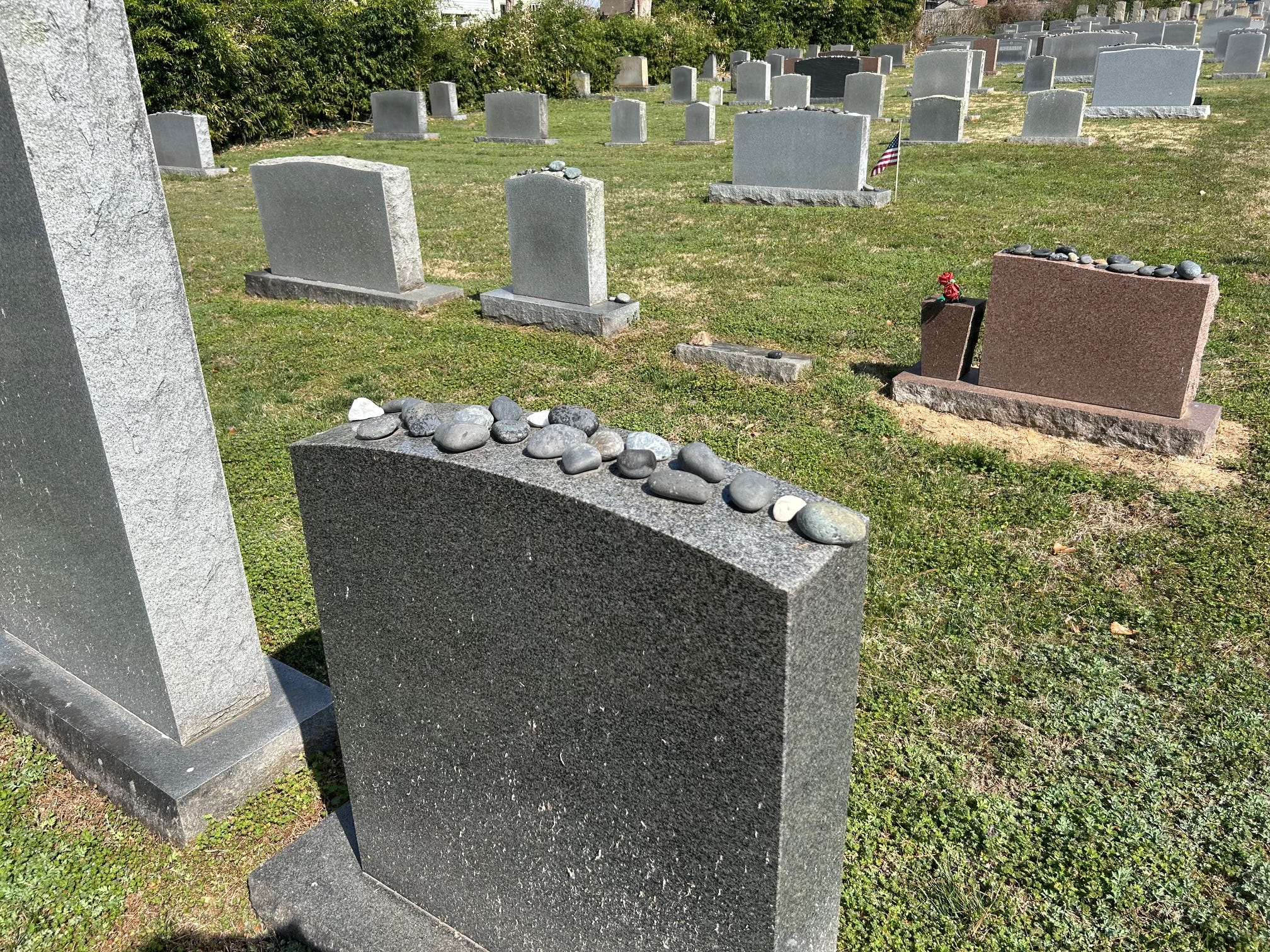
I absolutely love this custom, which might seem surprising given my love of Ecclesiastes, one of whose central points is to remind you that all will be ultimately forgotten — headstone, rocks, the person who lies beneath, the person thinking of the person who lies beneath, everyone that person knows in turn: all, ultimately, forgotten. You personally will die, and so will everyone you’ve ever known, and then you will be forgotten. These are the foundational realities of Ecclesiastes.
As its author, Qoheleth, tells us in 1:11, “There is no remembrance of former things, Nor will there be any remembrance of things that are to come by those who will come after.” Cheerful yet? He goes on in 2:16, reminding us that of good person or bad, wise man or fool, “there is no remembrance for ever; seeing that in the days to come all will long ago have been forgotten.” You’re here, you’re dead, and in the long run it’s like you were never even here. Woohoo!
And, mind you, as far as Qoheleth goes that actually sounds just fine, given our hopeless lives: “I praised the dead that are already dead more than the living that are yet alive,” he tells us ruefully, weary of this pointless struggle (4:2). Come to think of it, he goes on, we’d’ve been better off without the whole thing in the first place: “but better than they both is he that hath not yet been, who hath not seen the evil work that is done under the sun” (4:3). Okay, one more: “The heart of the wise is in the house of mourning,” he says in 7:4, “but the heart of fools is in the house of mirth.” And were you afraid his outlook was getting too rosy, he carries on in 7:8, “Better is the end of a thing than the beginning thereof.” Yes, I know that’s just vanity porn. Yes, I love it.
But again: it’s not just just better-off-dead: Qoheleth gets right back to his they’ll-never-remember-you bit, telling the story of a great power about to assault a tiny city. But wait! To the aid of the tiny city comes a poor wise man, who “by his wisdom delivered the city” (9:15). Which led to the medal of honor and a monument and a memory that lives to this day, to be sure?
Yeah, right. “Yet no man remembered that same poor man (9:15).” Nobody will remember us, good, bad, or indifferent. Nobody, nobody, nobody.
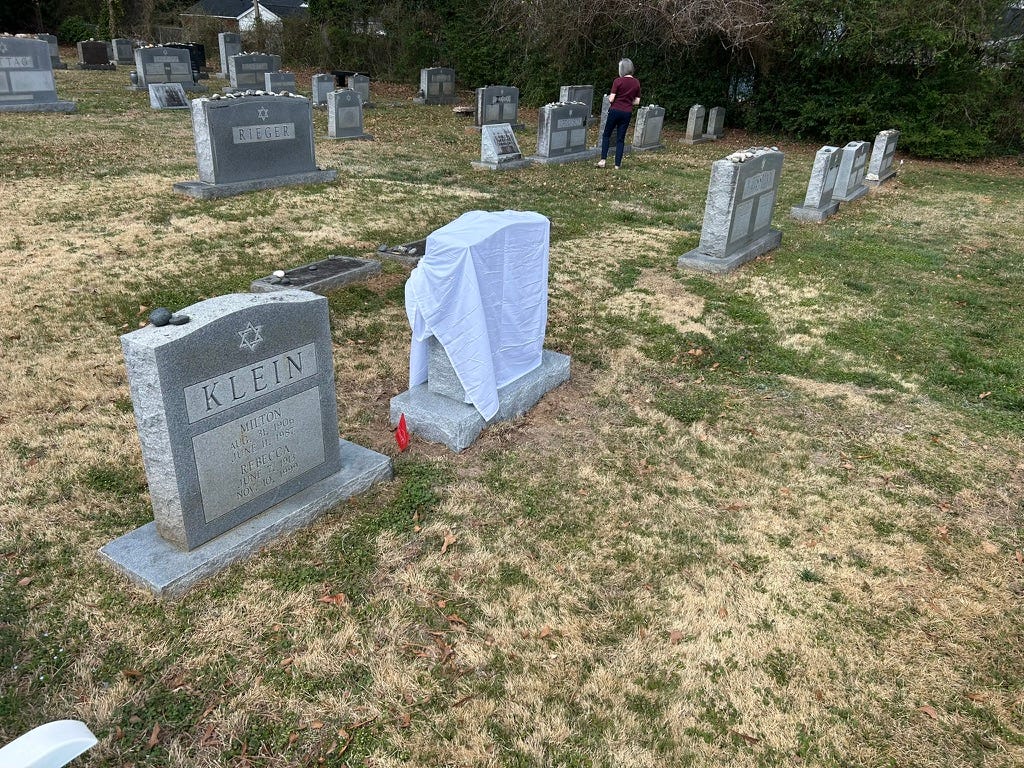
And yet here comes the Jewish custom of the headstone-setting (I grew up hearing it called a stone-setting; now I more often hear “unveiling”), a little less than a year after a death.
And I love it. Even though it clearly places value on long-term remembrance. And those rocks (I have seen them called visitation stones) are one of my favorite rituals of grief, mourning, and — again — remembrance, pointless though we understand that remembrance ultimately to be.
My friend Roger died about a year ago, so a few dozen of us recently attended his stone-setting.
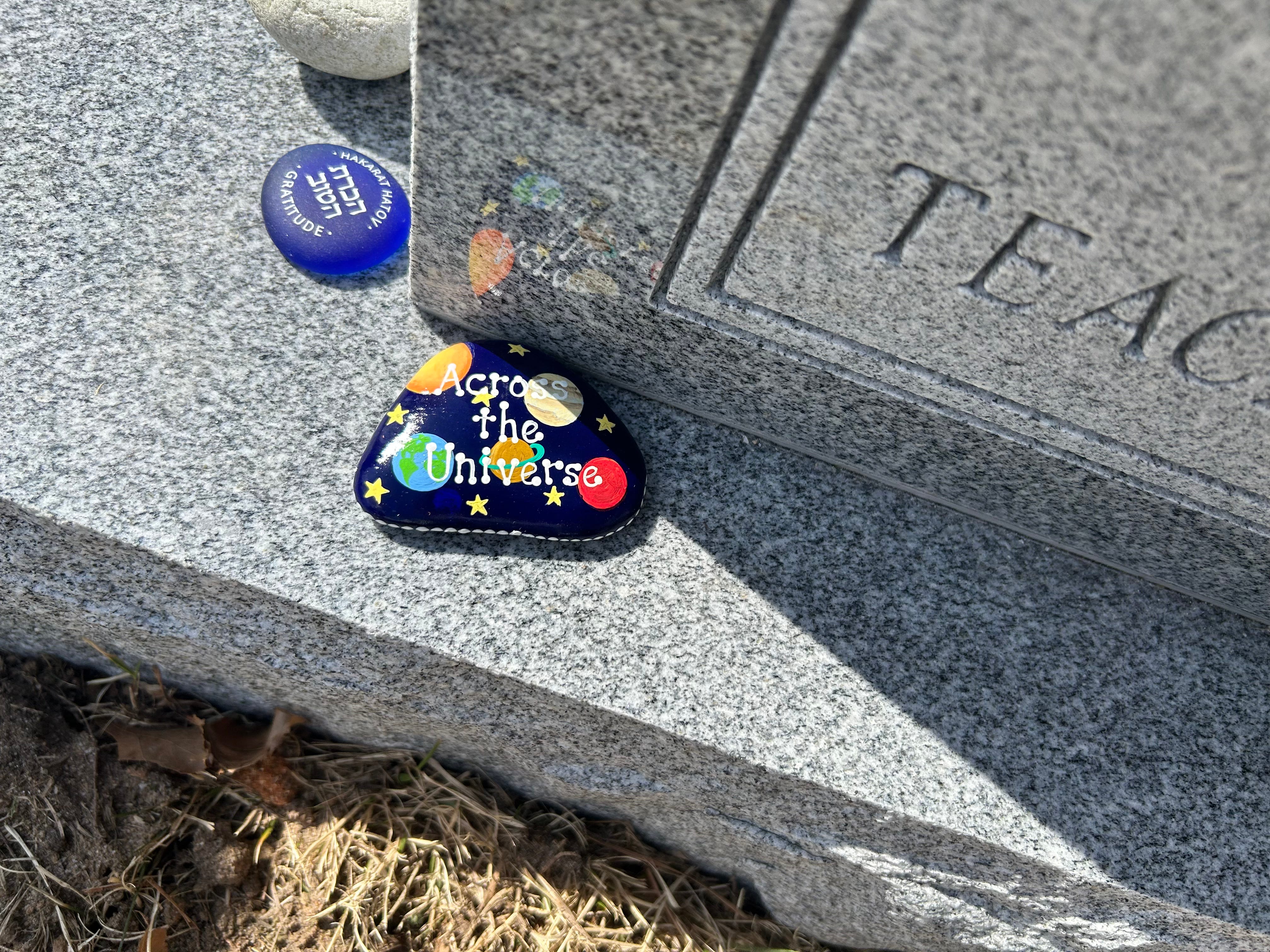
Anyway. My friend Roger died about a year ago, so a few dozen of us recently attended his stone-setting. The stone-setting comes sometime after the end of the third Jewish period of mourning: first comes Shivah (Hebrew for “seven,” the intense first week); next is shloshim (Hebrew for “thirty,” that endless first month); followed by 11 months, most of a year, of mourning.
Around the end of that eleven months a lot of things are happening. For one thing, the ground has settled, making it possible to put up a headstone that will not sink. For another, the anniversary — yahrzeit, Yiddish for “year-time”; we light a candle (I wrote about it here) — approaches, after which those in mourning start to fully reenter their lives. Not to make them as they were, of course, that will never be, and the year of mourning is a first, necessarily incomplete, embrace of that reality. But then you have to come back to the living. The stone-setting is a hinge point, a moment when we look back — at the person we miss, at who they were, at the funeral that was already a year ago. And we mark the moment with the headstone (and footstone, in some cases), and then we move forward.
It’s a sad and sweet and sorrowful and hopeful moment, a stone-setting. The rabbi at Roger’s talked about common Hebrew names for cemetery: beit olam (house of eternity) or beit kvarot (house of graves). But he chose as his favorite beit hachaim (house of life). Traditionally that phrase leans towards belief in an eternal afterlife, though Qoheleth wouldn’t be having any of that, of course. But the rabbi talked about a cemetery as being the house of life because it brings together the living, and sure enough there we all were, a few dozen of us, all brimming with life, with breathing and hugs and tears and laughter, sharing our life together because of Roger. From my scribbled notes I cannot tell whether the rabbi said, “We have to choose to live life,” or “We have to choose to love life,” and I don’t care that I can’t tell: they’re both true, they’re both beautiful, and they’re both entirely consistent with Roger — and Qoheleth.
Qoheleth of course, in the beats between his ceaseless reminders of how terrible and pointless everything is, breaks in to remind us that we might as well enjoy the ride, because, you know, dead, forgotten, all that: “Then I commended mirth, because a man hath no better thing under the sun, than to eat, and to drink, and to be merry: for that shall abide with him of his labour the days of his life“ he says in 8:15, or in 2:26, “For who can eat, or who can have enjoyment, more than I?” The enjoyment of these passing moments is what we have for comfort in our brief flash between the nothingness before us and the nothingness to come.
And yet we choose to commemorate — to use stone, no less, to remind us and to give the comforting implication that memory will outlast us. Jews tend to not send flowers to funerals specifically because they fade so quickly and remind those mourning of what they’re already too much reminded. Thus those rocks, and in the first place the headstone to put them on.
I have heard a headstone described as the headline of your life, though to me it’s a little more like a photo caption. But it makes Qoheleth’s point either way. A year ago the death was fresh and visceral and agonizing and expansive, requiring a long a full obituary; a year later it is real and sad but can be summed up in a few words. It gives space for breathing, for getting on with whatever is next. For time.
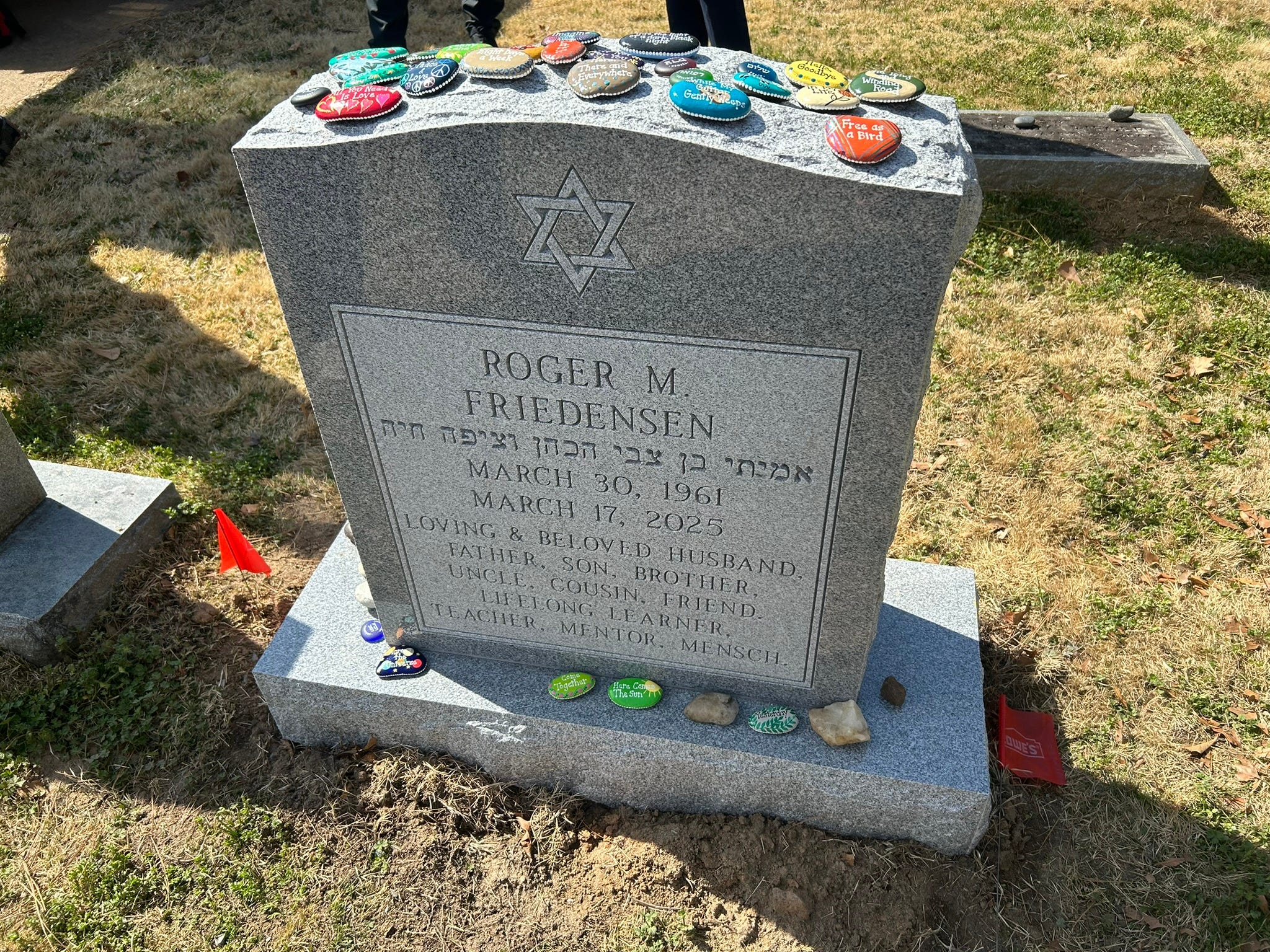
At the stone-setting we get to unveil the headstone and read that photo caption. In Roger’s case it listed his many roles — father, husband, friend — then moved on to teacher, mentor, and, far above all, mensch. In German “mensch” means “man,” but in Yiddish it takes on far more meaning: it denotes integrity and honor, decency and kindness, humor and humility. The guy who stays after practice with his own kids to wait until that one last parent gets there for that one last kid? So the kid doesn’t have to wait alone? That’s a mensch. I’ve heard people say, “Yeah, he’s a real one.” I think that gets to the same thing: if you’re a mensch you’re not a bigot, you’re not cheap, you’re not vicious. You’re looking in every situation to do what’s best for everybody, not just for you or yours. You’re not perfect, but every day you try to do what is best, and when you fail you acknowledge it with a sigh. Roger? All-day mensch.
Roger was a communicator, and so he gets the sendoff writers get, said originally by writer and editor Stanley Walker, and surely approved by Qoheleth: “When he dies,” Walker said of newspapermen in his autobiography, “a lot of people are sorry, and some of them remember him for several days.” Qoheleth would profoundly approve of that wry “several days,” and what is a stone-setting if not an acceptance of that very real, if heartbreaking, passage of time? And if the few dozen of us at the stone-setting were significantly fewer than the throngs at the funeral, how many fewer will there be next year, and the next? We’ll try to remember, but we know that our numbers diminish, as they must.
That diminution is part of the process. A year ago all was pain; now there is sorrow but also memory — albeit brief — and maybe the first vague stirrings of something that might ultimately be peace. We miss him, especially what is best about him, but with our sorrow comes acceptance that he is gone.
A few days after the stone-setting I was having such thoughts as these when The Great Algorithm served me this video, from musician, writer, and producer Elle Cordova. It’s a couple years old, but it speaks, like Qoheleth, to every day. I’d like to ask you to watch it now.
That is exactly what we all said, out in the warm sun on the green cemetery grass, waiting for the brief service. What would we give just for another half hour, before the disease, to have another conversation with Roger, another half-hour playing music. Even during the disease, another few minutes to laugh, to see, to just be together. But that won’t ever be again; instead we must be together without him. But who will we be without next year? Someone we’d treasure these moments with, in memory of our friend. So we stand together and we place our stones.
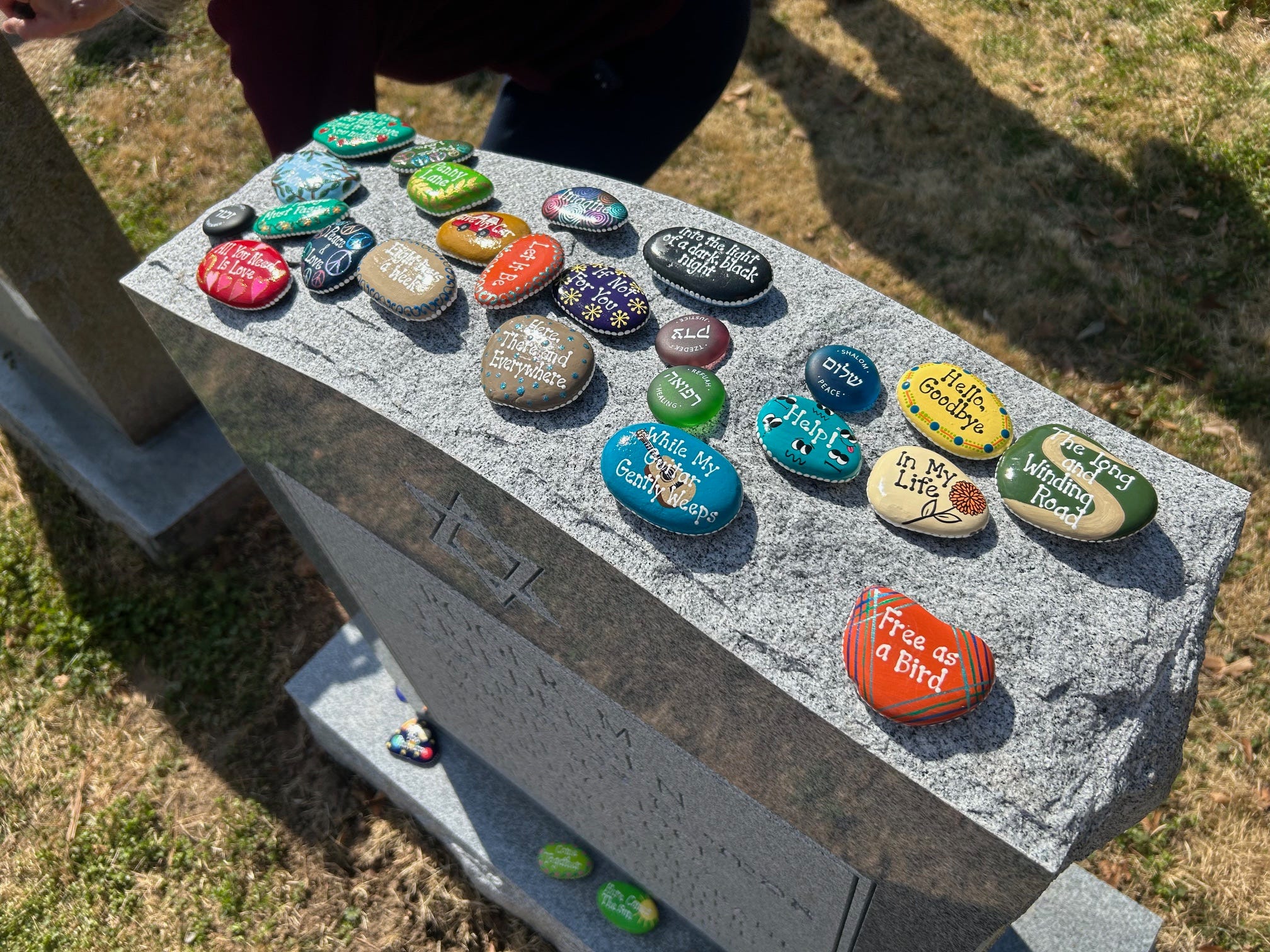
Oh yeah, those stones. A Jewish cemetery commonly has near the entrance an urn full of stones — so visitors can leave a stone on the grave they visit without filching one from another grave (or, one presumes, the gravel used hither and yon to stabilize earth or roads). To celebrate Roger and that tradition of leaving stones on a grave, Roger’s wife, Teresa, took a few dozen pretty smooth river stones, the kind you might find at a garden store, and took them to an artist, who she told that Roger loved the Beatles and George Harrison. Thus, in an open hatchback parked near the grave, a scattering of lovely, colorful stones, painted largely with the names and lyrics of Beatles songs, all with suddenly intensified meaning: “Imagine,” “Tomorrow Never Knows,” ‘Hello, Goodbye,” “The Long and Winding Road,” “Into the light of a dark black night.”
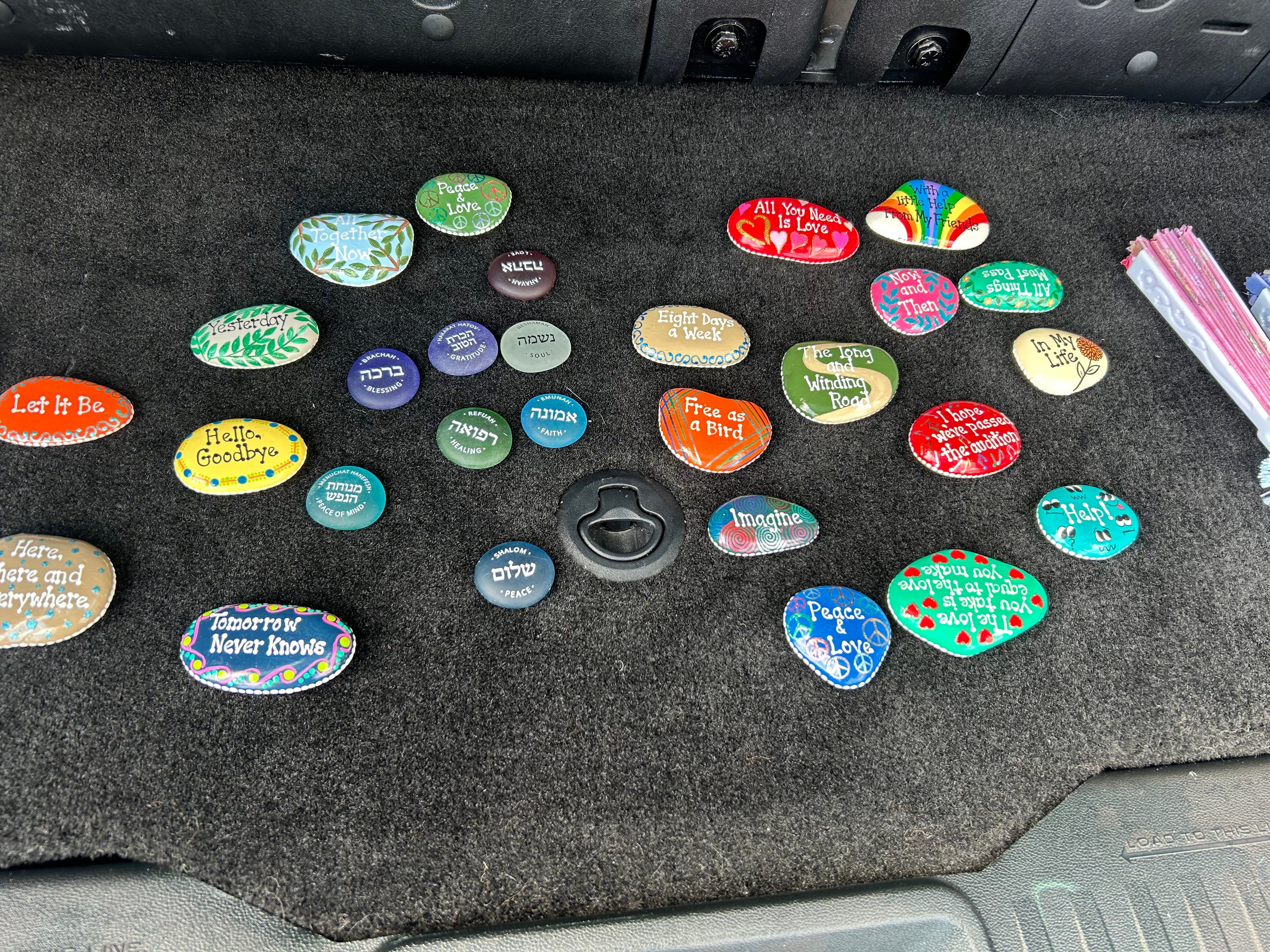
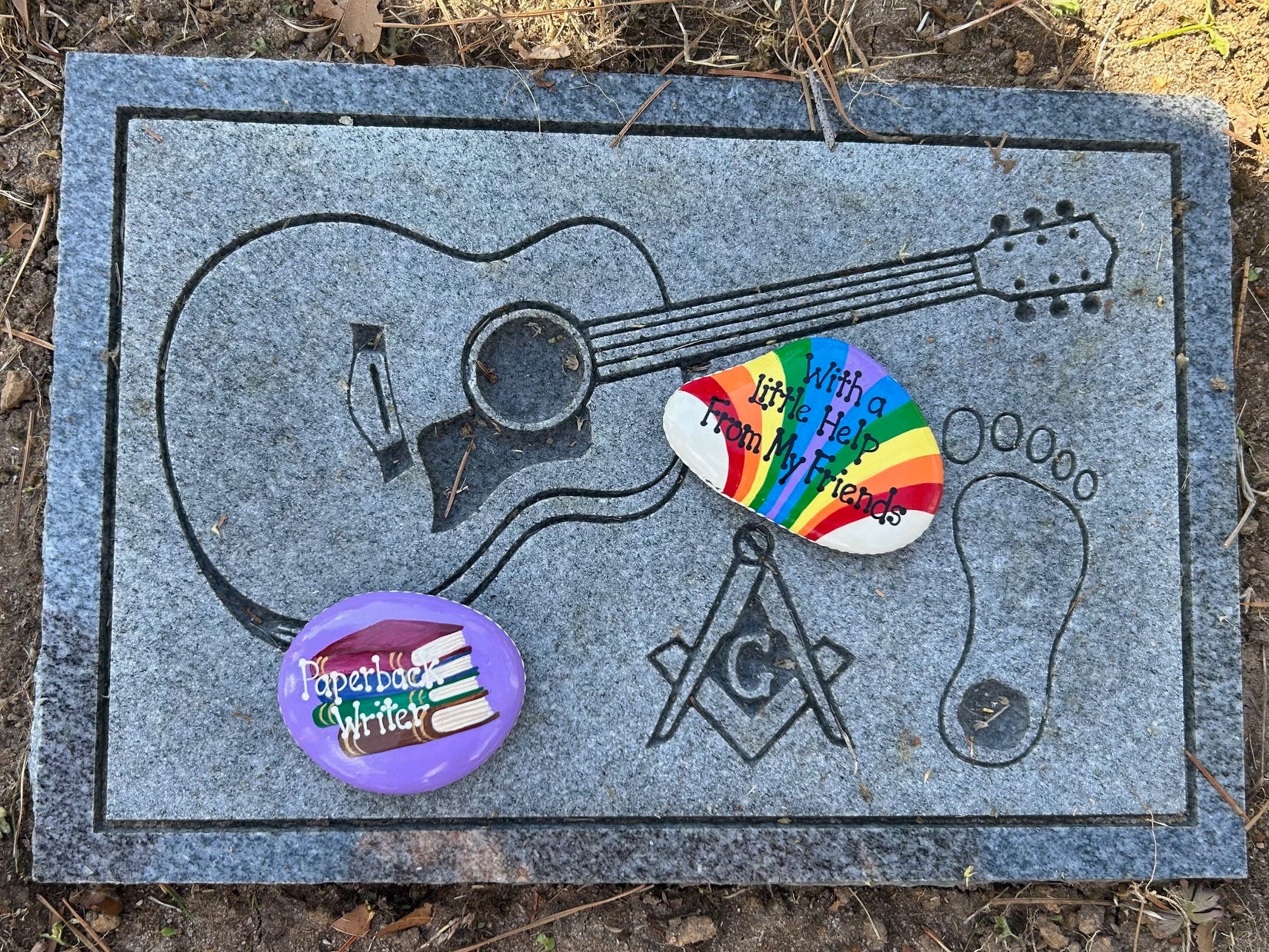
Some were available for anyone, others Teresa had wrapped for someone with a special connection. Mine? “Paperback writer.” It made me cry. My favorite was, “I hope we’ve passed the audition,” which as someone who played music with Roger for years I heard him say surely no less than a hundred times. Probably more than that.
The rabbi mentioned that the tradition of the headstone itself may have emerged from primitive customs of building a cairn upon a grave. My mom used to tell me it was “so they should know you came to visit,” which implies a kind of awareness, either there beneath the headstone or somewhere else, that for me raises way too many questions to answer.
For me leaving a stone just feels like a way to complete the gesture. Like most funerary traditions the gesture is for the living. I left a stone not for Roger, not even for me. I left it so that whoever comes by next will say, “Look at that! People loved that dude.” I mean, they’ll say that for a while, until the paint runs and the stones erode and time goes on and, like the older headstones in the cemetery, there is nobody left to remember. Like Qoheleth says, if we could only stand to listen.
The week we die, so much grieving! A year later, there are still people grieving, enough for a well-attended stone-setting. A few years, decades later? A few people. A couple decades more? Who remembers? I can tell you hours of stories about my parents, even my grandparents. About my great-grandparents? I met them, know their names, can give you those photo-caption details. About their parents? I don’t know a name, don’t have a picture, don’t know a thing. Three generations: gone like a puff of smoke. And we’re a family of ancestor-worshipers, I promise. We love our stories. And three generations along the stories, like those in them, gone. “There is no remembrance of former things, Nor will there be any remembrance of things that are to come by those who will come after.”
I mean, you can’t dispute it, right? We’re all headed to the same place, and there’s been some hundred billion of us since we first showed up a couple hundred thousand years ago. How many do you remember? Kinda makes you think.
“In the long run we are all dead,” economist John Maynard Keynes famously wrote in 1923, though of course Qoheleth got there long before Keynes did. The point is undeniable: in the long run we will not be remembered; in the long run we’re all dead.
But in the short run we’re all still here. Which means the short run is all that counts.
So get together.
Leave a stone.
Stunningly beautiful
Scott, what a joy to read this… your thoughtful dvar, a reflection upon a day, a shared few minutes, hours, has given us words to interpret and remember. And what a gift from Teresa! The act of selecting the stone brought silent music to the day, a flood of feelings about Roger and each person’s personal relationship, music made together. And then there were the conversations that began with ‘which stone did you pick?’ To Qoheleth and Scott, consider one more Jewish tradition of remembrance: giving a Jewish name that honors a family member no longer living. In conversations about who we were named for, and who they were named for, and so on, back through the generations, we remember.