
Yahrzeit
On Lighting a Candle in the Darkness
I have been discussing Ecclesiastes purely for its content: its adjurations to give up on plans and hopes, its remonstrances that we simply put one foot in front of the other and carry on as best as we can, its reminders that nothing we are experiencing is new and that we’re all going to die anyway. All of which I entirely believe.
But I’ve until now been ignoring, or at least dancing around, its status as a Jewish book — it’s part of the Jewish bible, the Tanach: the Torah (the five Books of Moses), the Nevi’im (the Prophets, books like Ezekiel and Isaiah), and the Ketuvim (Writings, including books like Job, Psalms, and of course Ecclesiastes).
So speaking of which. When we Jews celebrate our holiest days, as we did the last weeks, Ecclesiastes naturally comes up, but I had not noticed before how profoundly Ecclesiastes fits with both the High Holidays, especially Yom Kippur. Rosh Hashanah is a cycle holiday — the beginning of the year, the renewal of the cycle — so not only the well-known “to everything there is a season” (3:1-8) resonates but so does the very start of the book:
“The sun also ariseth, and the sun goeth down, and hasteth to the place where he ariseth.”
“The sun also ariseth, and the sun goeth down, and hasteth to the place where he ariseth,” Qoheleth tells us at the start of the book. “All the rivers run into the sea, yet the sea is not full …. All things toil to weariness; man cannot utter it…. That which hath been is that which shall be, and that which hath been done is that which shall be done; and there is nothing new under the sun ” (1:5-9).
That doesn’t exactly scream, “I am important,” which is salutary and one of Qoheleth’s main points: you are NOT important, it’s just another year come and gone. But again: that’s the cycle holiday. That’s big-picture, philosophical stuff: how much does your life matter, it’s all the same old story over and over, isn’t it. Conceptual stuff.
Then comes Yom Kippur, which of course is the day of atonement, but much more important for our purposes is that it’s the day we completely acknowledge that we’re all just here until we croak. We recite prayers listing the many errors and sins we have committed over the preceding year, and we overtly remind ourselves: uh-oh; we might die this year. We say in both services and throughout the ten days between the holidays that we hope to be inscribed in the Book of Life for the coming year. In the profound prayer Unetanneh Tokef (“let us speak of the awesomeness”) spoken during both holiday services, we say, “On Rosh Hashanah it is written, and on Yom Kippur it is sealed … who shall live and who shall die.” So death is with us throughout the ten Days of Awe, as we call them.
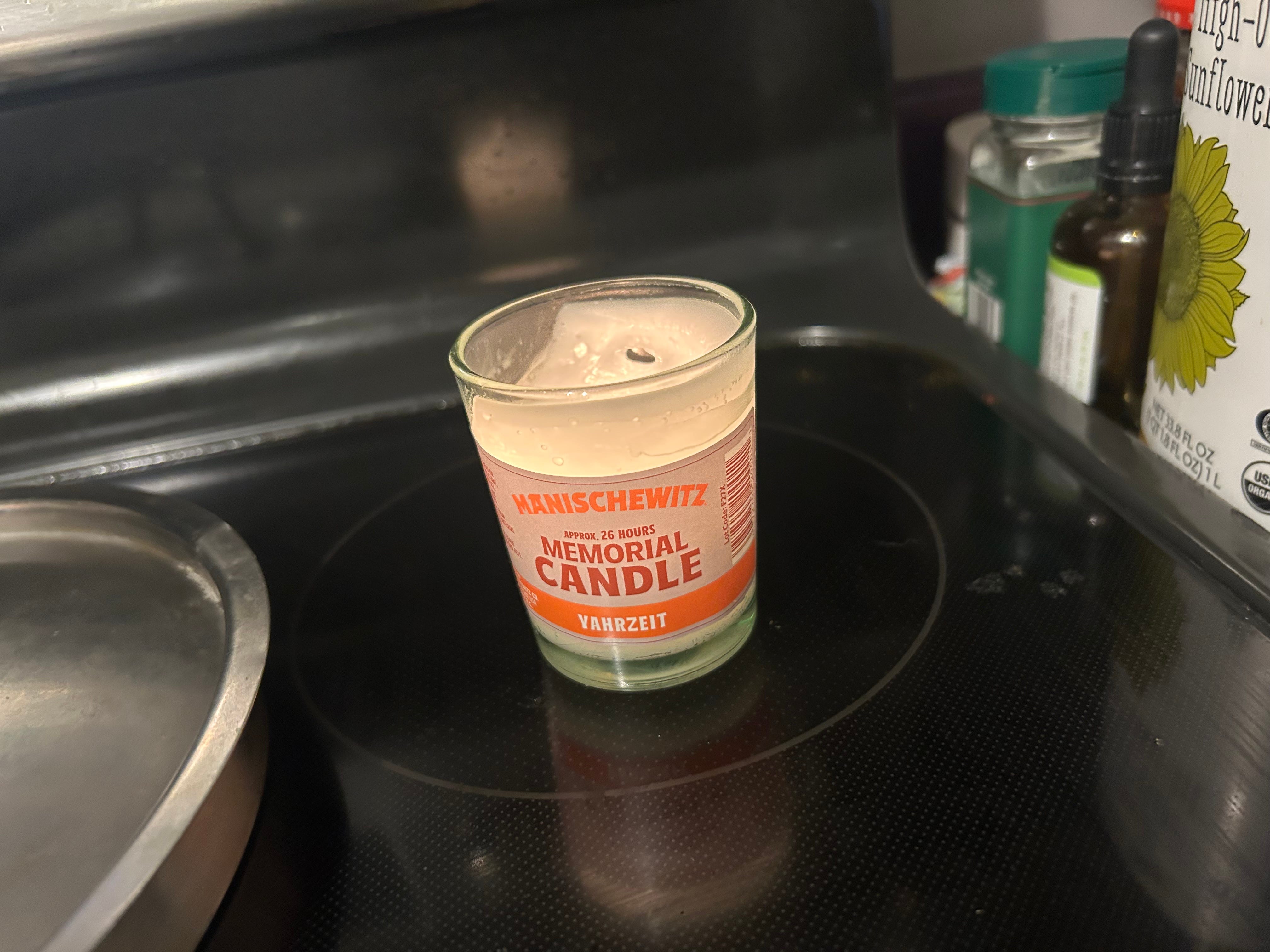
And to remind ourselves of that awesomeness, on Yom Kippur (as we do on several other holidays), we burn a yahrzeit candle.
A yahrzeit candle is a little candle that Jews burn not just on those special holidays but, more importantly, on the anniversary (yahrzeit is Yiddish for “anniversary”) of the death of a loved one, a tradition that likely goes back two thousand years. You get yahrzeit candles in the Jewish section of your grocery store or pharmacy; little glasses with a candle inside, which burns for about 30 hours usually. I love lighting them for my dad; he always burned his, for holidays and his parents, on the stove, so that’s where I burn mine: “Hi daddy,” I say when ducking into the kitchen for a drink or snack on the evening of the anniversary of his death. It’s a conscious, peaceful, even loving acknowledgment of death.
Which is a big part of Ecclesiastes, of course. “All go to one place;” Qoheleth tells us (3:20) “all are of the dust, and all return to dust.” Or, “It is better to go to the house of mourning, than to go to the house of feasting, for that is the end of all men” (7:2). And of course, “there is no work, nor device, nor knowledge, nor wisdom, in the grave, whither thou goest” (9:10). Qoheleth likes to remind us we’re going to die. He thinks we should keep that in mind. He likes to remind us that after a little while nobody will remember us, but let’s talk about that another time. For now let’s stick just with death.
He’s not wrong. Death is part of what makes the High Holidays so profound. Qoheleth would like us to keep death in mind every second, but truly none of us are up to that challenge.
So it’s nice if once a year we take it to heart, burn that little candle, wonder whether we’re going to make it another year. In fact, that’s a central part of Unetanneh Tokef prayer. Not just who shall live and who shall die but how: “Who shall perish by fire and who by water; who by sword and who by beast; … who by earthquake and who by plague.” You don’t get to just airily say, “yeah, might die.” You have to think of how that might happen, and when, what it might be like. It has to be real.
Leonard Cohen wrote a lovely song about that prayer: “Who by Fire.”
And the prayer finishes with a section that reads like it could have come directly from Ecclesiastes: “Our origin is dust, and dust is our end,” the prayer says. “Each of us is a shattered urn, grass that must wither, a flower that will fade, a shadow moving on, a cloud passing by, a particle of dust floating on the wind, a dream soon forgotten.” These words echo Ecclesiastes almost word for word.
We are little flashes of awareness, little lives alive for tiny moments. We could die at any second — sometimes we do (more on that next post). Whatever we have going on, it is truly as a tiny, flickering flame in a place of enormous darkness.
We are dust on the wind, a cloud passing by, a blade of grass sure to die. Our lives are brief and pointless. But here they are, and here we are. We have these brief nows to manage, or anyhow to live through, to experience.
So burn a little candle. Acknowledge the closeness of that guy in the hooded cowl carrying the scythe; he’s not so scary, he’s just the guaranteed end of all this foofaraw. Keep it in mind. Burn a yahrzeit. It’s wonderfully helpful for concentration on what’s important to you.
And if nothing else, isn’t a little flame pretty? We all have to die. While we’re here we can kindle a little light in the darkness.