
Linus Shows Up
Which Turns Out to Be Pretty Much the Whole Deal
“Everything I touch gets ruined.”
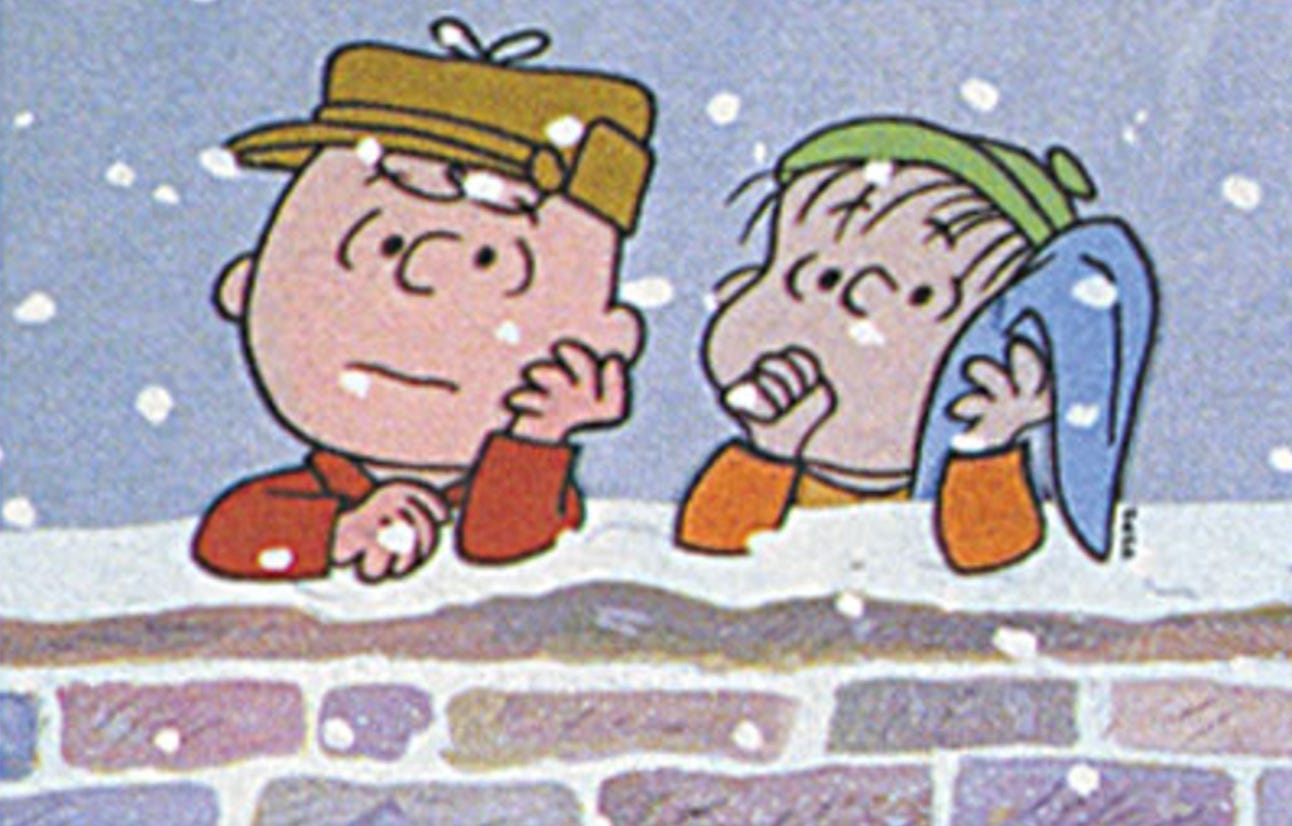
That’s Charlie Brown when the single ornament he’s placed on his fragile little tree in “A Charlie Brown Christmas” almost kills it. “Everything I touch gets ruined.” Or, to translate: “Vanity of vanities; all is vanity” (1:12 and almost everywhere else).
Charlie Brown is like the object lesson of Ecclesiastes: he’s not Qoheleth; he’s the life that Qoheleth tells us about. Everything goes wrong. Stuff just happens. Pursuing your ends is absurd and empty. More, it’s the same damn thing over and over: “The thing that hath been, it is that which shall be, and that which is done is that which shall be done: and there is no new thing under the sun” (1:9). Or, translated: “I’ll hold the ball, and you come running and kick it.” (In fact, one strip in 1980 has Lucy justifying pulling away the ball with Ecclesiastes: “To every thing there is a season … and a time to pull away the football,” which of course refers to 3:1.
But what makes “A Charlie Brown Christmas” an Ecclesiastes all-star is not Charlie Brown demonstrating over and over that as Qoheleth says, “all is vanity.” What takes it to the next level is Linus.
Charlie Brown spends most of the special moving from one failure to another. The mailbox, the play, the tree: he’s a past master at having things go wrong. He’s like the disappointments of Ecclesiastes made flesh. “Don’t expect anything to come of your efforts,” Qoheleth tells us verse after verse. And Charlie Brown is the example: “See?” he turns to us and says.
But Ecclesiastes also has that other side, the side that saves us: Qoheleth tells us to eat drink and be merry (“Then I commended mirth, because a man hath no better thing under the sun, than to eat, and to drink, and to be merry” 8:15, for one). Because Qoheleth also tells us that “Two are better than one; because they have a good reward for their labour. For if they fall, the one will lift up his fellow: but woe to him that is alone when he falleth; for he hath not another to help him up. Again, if two lie together, then they have heat: but how can one be warm alone? And if one prevail against him, two shall withstand him; and a threefold cord is not quickly broken.”
That’s 4:9-12, and I think it offers more than just the reminder that two people can stand up to a bully better than one. I think that business about warmth is key — this is about not just safety but comfort.
We think about the old saw “misery loves company,” and often I think we interpret that to express how ugly we are when we’re unhappy — we are jealous of others’ happiness and would rather they were miserable along with us. I mean, true enough, especially when we’re feeling small or punky. It’s hard to enjoy someone else’s happiness when we’re miserable.
But I think these lines — and wise little Linus — remind us of something much sweeter, and much more soothing. Misery does love company — but it loves it because when we’re miserable we want someone to pat us, or say ‘there, there” to us, or just sit peaceably by us while we weep, or sulk, or bellyache.
Enter Linus. Linus is perfect example of friendship. Linus is just there. Charlie Brown screw up, there’s Linus; Charlie Brown makes a fool of himself, there’s Linus. Not criticizing, not critiquing, not even offering help. Just being there. Sure, Linus is the one who reminds everybody of the true spirit of Christmas, but then again isn’t that how it always goes? The person who’s just sticking around, trying to be a good egg, not trying to run the show, turns out to have the answer if anyone will just ask?
But that’s not really the point. The point isn’t that Linus knows the secret of Christmas. The point is that Linus is there. Over and over, always, continually: Linus is there. He’s the warm body, the friendly ear, the arm around the shoulder, the fully accepting friend: what is just is; let’s try to accept it and just live with it, shall we?
Yes — everything we touch gets ruined. That’s how it is. But come on over here next to me and let’s just be together and maybe it won’t feel so bad.
Or even if it does, at least we’ll be together.
Perfect. Just perfect!
Catherine
Scott
I loved this!